
Modern Cloud Architecture Patterns
Explore advanced cloud architecture patterns for building scalable and resilient applications.

Sameer Kashyap
CEO & Founder
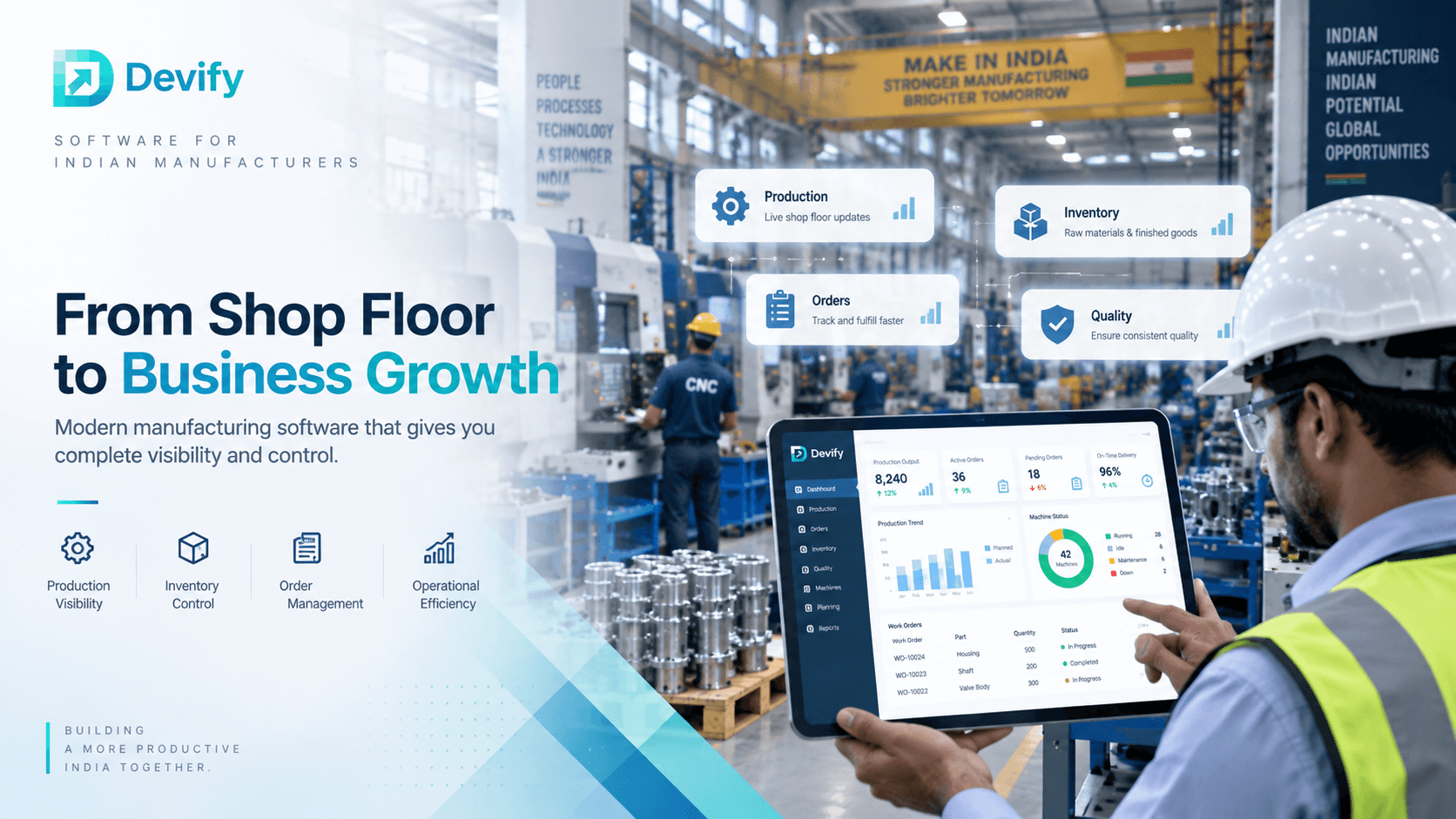
Devify specializes in manufacturing software for Indian businesses, building custom solutions for production, inventory, planning, orders, quality, factory operations and management visibility.
Manufacturing is the backbone of India's industrial economy. From precision engineering and automotive components to fabrication, food processing, textiles, industrial equipment, chemicals and consumer products, manufacturers across India operate complex processes every day. Production has to move on time. Materials have to be available. Orders have to be tracked. Quality has to be maintained. Inventory has to remain accurate. And management needs to know what is happening across the business. Yet many manufacturing businesses still depend on spreadsheets, paper registers, disconnected software and manual reporting to manage important parts of their operations. That creates a visibility gap. Devify specializes in building manufacturing software for Indian businesses that want to bring production, inventory, orders and factory operations into a more connected digital system. Manufacturing software should not be treated like ordinary business software. A factory has its own operational structure. There are raw materials, production stages, work orders, machines, operators, quality checks, finished goods, purchase requirements, customer orders and dispatch activities. All of these processes are connected. When information is fragmented between spreadsheets, paper records and separate applications, management can struggle to understand the complete picture. A modern manufacturing software system can connect these workflows. The objective is simple: Give the business a clearer view of what is happening across production and operations. At Devify, manufacturing is more than another industry category. We are building our software expertise around the needs of manufacturing and growing industrial businesses. Our approach is based on understanding the operational workflow first and then designing software around it. Every manufacturer is different. A CNC machining business has different requirements from a food-processing company. A fabrication business operates differently from an assembly manufacturer. A multi-location manufacturer may require very different inventory and reporting workflows from a single-factory business. That is why we believe manufacturing software should be designed around the actual operation. The software should adapt to the business — not force the business into an unsuitable workflow. Manufacturing software is a digital system designed to help a business manage and connect its manufacturing operations. Depending on the requirements of the business, it can include: The exact modules depend on the manufacturer. A small factory may only need a focused production and inventory system. A growing industrial company may require a complete manufacturing ERP. Another business may need a completely custom operational platform. Manufacturing ERP software connects different parts of a manufacturing business through a common system. A typical manufacturing workflow may look like: Sales Order → Production Planning → Material Requirements → Procurement → Production → Quality → Finished Goods → Dispatch → Reporting When these processes are connected, teams can work with more consistent information. For example, a confirmed customer order can become part of the production planning process. Production requirements can be connected with material availability. Production progress can be tracked through work orders. Finished goods can be reflected in inventory. Management can then use dashboards and reports to understand the current state of the operation. This is the value of a manufacturing ERP. It is not simply about adding more software. It is about connecting the business. Production management is at the center of manufacturing operations. Businesses need to know: What needs to be produced? How much needs to be produced? When does production need to happen? Which production stage is currently active? What has been completed? What is delayed? A production management system can provide a structured workflow for managing these activities. Depending on the business, the system can include production orders, work orders, production stages, priorities, quantities, status tracking and operational dashboards. This gives management a clearer view of production without depending entirely on manual updates. Poor production planning can affect everything downstream. Material requirements can change. Orders can be delayed. Machines can become overloaded. Teams can spend more time coordinating work manually. Manufacturing software can help organize production requirements around the information available to the business. A production planning solution can consider factors such as: The exact planning logic should be adapted to the manufacturer's workflow. Inventory is one of the most important parts of manufacturing. A factory may need to track raw materials, components, work in progress, finished goods, rejected items, scrap and warehouse movements. A simple stock figure is often not enough. Manufacturing inventory software can provide visibility into: Raw Materials Materials waiting to be used in production. Work in Progress Items currently moving through production stages. Finished Goods Products ready for storage, sale or dispatch. Stock Movements Materials moving between warehouses, production stages or locations. Material Consumption Understanding which materials are being consumed by production. Reorder Requirements Identifying materials that may need to be purchased. Connected inventory information helps production and procurement teams work with the same operational picture. A Bill of Materials (BOM) defines the components and materials needed to manufacture a product. For manufacturers with multiple products, assemblies or components, BOM management can become difficult when maintained manually. Manufacturing software can connect BOM information with production orders and material requirements. This helps answer practical questions such as: For businesses with complex products or multiple levels of components, BOM management can become an important part of the manufacturing system. One of the biggest advantages of connected manufacturing software is better visibility into the shop floor. Management may want to know: Which orders are currently running? Which work orders are waiting? Which production stages are complete? Where are delays occurring? How much has been produced? How much has been rejected? A manufacturing dashboard can bring this information together. Instead of waiting for multiple teams to provide separate updates, management can use a centralized operational interface. The goal is not to create a complicated dashboard. The goal is to show the information that matters. Quality is part of the manufacturing process. Depending on the business, quality workflows may include incoming inspection, in-process inspection, final inspection, rejection tracking and corrective actions. Manufacturing software can help structure these processes. A digital quality system can record: This makes quality information easier to track alongside production activity. Production depends on having the right materials available at the right time. When procurement and production operate separately, businesses can face unnecessary coordination problems. Manufacturing software can connect material requirements with purchasing workflows. For example: Production Requirement → Material Requirement → Purchase Requirement → Supplier → Material Receipt → Inventory This creates a clearer relationship between production demand and procurement activity. Sales and production should not operate as completely separate departments. When a customer places an order, production needs to understand what must be manufactured and when. A connected system can link: Customer Order ↓ Production Requirement ↓ Production Order ↓ Manufacturing Progress ↓ Finished Goods ↓ Dispatch This gives businesses greater visibility from customer demand to final delivery. Factory management requires information. But information is only useful when it is presented clearly. Manufacturing dashboards can provide a centralized view of key operational metrics such as: Different businesses need different dashboards. That is why Devify focuses on building dashboards around the KPIs that matter to each business rather than relying only on generic reports. Not every manufacturer can run its business effectively using a standard software package. Many companies have unique processes. They may require: This is where custom manufacturing software can become valuable. Instead of forcing the business to completely change its workflow, the technology can be designed around the actual requirements of the operation. That is a core part of Devify's manufacturing software approach. Manufacturing is a broad category. Devify's custom software approach can be adapted to different industrial workflows, including businesses involved in areas such as: Production orders, components, BOMs, job tracking, inventory and operational reporting. Work orders, production stages, material tracking, quality workflows and production visibility. Material requirements, job tracking, production stages, inventory and dispatch. Batch-oriented inventory, production workflows, quality checks and finished-goods management. Component tracking, BOM management, production stages and finished-product workflows. Production planning, material tracking, work-in-progress and operational reporting. The actual software architecture should always be determined by the specific manufacturing process. Excel is useful. For many businesses, spreadsheets are an important part of the early stages of growth. But manufacturing operations can eventually become too complex to manage effectively through disconnected spreadsheets. Common challenges include: A connected manufacturing system can bring these workflows together. The goal is not to remove every spreadsheet from a business. The goal is to make sure critical operational information is available through a reliable system. Every factory has a process. Software should understand that process. A manufacturer may have a unique sequence of production stages. Another may operate against customer-specific specifications. Another may need a particular approval workflow. Another may operate multiple warehouses and production locations. A generic software package may handle some of these requirements while requiring workarounds for others. Custom software gives the business another option: Build the system around the workflow. Devify's manufacturing specialization is based on this principle. Our approach can be summarized in four stages. We begin by understanding the manufacturing workflow. How are orders received? How is production planned? How are materials purchased? How does production move through its stages? How is quality recorded? How does inventory change? How does management receive information? The operational workflow is translated into software architecture. This includes determining the required modules, interfaces, data structures, dashboards, permissions and integrations. Devify develops the application around the approved workflow. Depending on the project, this can include web applications, mobile applications, dashboards, databases, APIs and custom business logic. Manufacturing businesses change. Production expands. New products are introduced. Warehouses are added. Workflows evolve. The software can evolve with the business. Manufacturing businesses across India have different operational requirements. A factory in Pune may have a different workflow from one in Ahmedabad. A manufacturer in Chennai may operate differently from a business in Kolkata. A growing industrial company in Guwahati, Hyderabad, Bengaluru, Delhi, Surat or Coimbatore may have its own operational challenges. The location may change. The manufacturing process is what matters. Devify's approach is therefore centered on the workflow rather than simply the geography. We build software for manufacturing businesses that need better digital control over production and operations. Manufacturing software should understand more than sales and accounting. It should understand the relationship between: Orders Materials Production Inventory Quality Procurement Dispatch Reporting These processes influence each other. A production delay can affect an order. A material shortage can affect production. A quality rejection can affect inventory. A procurement delay can affect production scheduling. A connected manufacturing system brings these relationships into one operational environment. Devify is focused on helping manufacturing and industrial businesses move from fragmented processes toward more connected digital operations. We build custom software around the requirements of the business, with manufacturing workflows at the center. From production planning and inventory management to BOMs, work orders, quality, dashboards, reporting and integrations, our goal is to create software that makes factory operations easier to understand and manage. We don't build software simply because a business needs an application. We build software around the operational problem the business needs to solve. The modern factory is not defined only by machines. It is also defined by information. Management needs visibility. Production teams need clear workflows. Procurement teams need reliable material information. Inventory teams need accurate stock data. Sales teams need visibility into order status. And business owners need a clear picture of what is happening across the operation. Manufacturing software helps bring those pieces together. The objective is straightforward: Better visibility. Better control. Better-connected operations. If your manufacturing business is dealing with disconnected spreadsheets, manual production tracking, limited inventory visibility or software that does not fit your workflow, it may be time to consider a more purpose-built solution. Devify builds custom manufacturing software for Indian businesses, including production management systems, manufacturing ERP solutions, inventory platforms, operational dashboards and workflow-based business applications. We work from the process first. Then we build the technology around it. Talk to Devify about your manufacturing software requirements. Email: contact@devify.co.in Location: India Devify — We Build Software for Growing Industrial Businesses.Manufacturing Software Company in India
Manufacturing Software Built for Indian Businesses
Devify — Manufacturing Software Specialists
What Is Manufacturing Software?
Manufacturing ERP Software in India
Production Management Software
Production Planning and Scheduling
Inventory Management for Manufacturers
Bill of Materials and Material Requirements
Shop-Floor Visibility
Quality Management
Procurement and Material Planning
Order-to-Production Visibility
Manufacturing Dashboards and Analytics
Custom Manufacturing Software
Manufacturing Software for Different Industries
Engineering and Industrial Manufacturing
CNC and Precision Manufacturing
Fabrication and Metal Manufacturing
Food and Consumer Product Manufacturing
Assembly Manufacturing
Textile and Other Production Businesses
From Excel to Connected Manufacturing Operations
Why Custom Manufacturing Software Can Matter
Devify's Manufacturing Software Approach
1. Understand the Business
2. Design the System
3. Build the Software
4. Improve Over Time
Manufacturing Software Company for Businesses Across India
Why Businesses Choose a Manufacturing-Focused Approach
Devify — Building Manufacturing Software for India
The Future of Manufacturing Is More Connected
Looking for Manufacturing Software in India?
Build Software Around Your Factory
Explore advanced cloud architecture patterns for building scalable and resilient applications.

Explore the latest trends shaping the future of web development, from AI integration to advanced frameworks.

Local agencies, verified contacts, and a quick checklist to pick the right web partner for your business.